Max’s Kansas City – An Iconic Club

On Park Avenue in Manhattan there stands a small, unassuming building. Once, it was one of New York City’s most iconic nightclubs: Max’s Kansas City. From the moment it opened in 1965, it became a magnet for artists, musicians, and cultural pioneers.

In its early years, Max’s was synonymous with Andy Warhol and his entourage. Warhol practically held court there nightly, bringing along The Velvet Underground, who often performed regularly in the intimate space. As the glam rock scene emerged, Max’s transformed into its unofficial headquarters. David Bowie, Marc Bolan, Iggy Pop, and Alice Cooper all became regulars.

One unforgettable moment in Max’s history occurred in July 1973. Two young acts shared the stage for a week of performances: Bruce Springsteen, promoting his debut album, and Bob Marley and the Wailers—then simply called The Wailers, who were the opening act for all of these performances. Their shows took place in the club’s upstairs showroom, with fewer than 50 people in attendance each night. Imagine witnessing Springsteen and Marley perform together in such an intimate setting!

By the mid-1970s, the art crowd began to fade from the scene, and glam rock was in decline. Max’s briefly closed but reopened in 1975, this time becoming a cornerstone of the punk rock movement. While CBGB often grabs the spotlight, Max’s was equally crucial in shaping punk’s early days. Every major New York punk band performed there, and Debbie Harry, who later fronted Blondie, worked as a waitress in Max’s before finding fame.

The club hosted some legendary moments in punk history. After the Sex Pistols disbanded, Sid Vicious played all of his solo gigs at Max’s. Devo also graced the stage, once introduced by none other than David Bowie. And for me personally, there’s a special connection: the first band I ever saw as a teenager back in Swindon, England—Crazy Cavan and the Rhythm Rockers—they also performed at Max’s.

Max’s Kansas City closed its doors in 1981, but not before hosting one final legendary show. The headliners? Bad Brains. The opening act that night was a fledgling New York group called the Beastie Boys.

The sheer talent that passed through Max’s Kansas City is astonishing. It was more than a venue—it was a cultural hub, a place where legends were born, and stars gathered to witness history in the making. While I’ve only scratched the surface of the artists who performed there, the list includes everyone from Emmylou Harris to the Talking Heads. And it wasn’t just about the acts on stage. Many future stars were part of the audience, soaking in the magic of a place that epitomized the creative energy of its era.
The Ghost of the Bushwick Savings Bank

Join us as we investigate the mysterious Ghost of the Bushwick Savings Bank in Brooklyn! This video takes you through the haunted history and eerie experiences reported by locals. Whether you’re a believer in the supernatural or just curious, you won’t want to miss this captivating journey into the unknown!

On March the 27th, 1916, the Brooklyn Daily Eagle reported a story of some ghostly activity happening at the bank on the corner of Grand St. and Graham Ave. in Williamsburg.

In this video I have taken that newspaper article and I have created a fun scary story based on the details in the article. It is Halloween after all, and what better way to celebrate than to listen to a scary story.

The Ramones Ramp

Today I visit Forest Hills in Queens for a look at The Ramones Ramp. All four original members of the band would hang out here in the 1970s and they all went to school just up the road at Forest Hills High School. It might be a stretch to call the place the ‘Birthplace’ of punk, what with earlier pioneering bands such as Television, MC5 and The Stooges, but The Ramones certainly brought their own style to the punk scene and can definitely be considered pioneers as well.

Top 25 New York City #shorts Videos

Over on my Youtube channel I have created a playlist of my top 25 #shorts videos from NYC. Many of the top shorts feature either the NYPD or the FDNY. If you start the video the top 25 should start playing in their ranking order. The majority of my videos are filmed in Ridgewood, Maspeth and Bushwick.

In Flanders Fields Audio Recording

A while back I made my own recording of In Flanders Fields by John McCrae. Youtube #shorts videos run for a minute or less and I was just about able to squeeze the poem into 59 seconds. This is one of my better recordings.

The clip above was extracted from my narrated story on the Remsen Family cemetery in Rego Park, Queens.

Be sure to check out all of my New York stories on my YOUTUBE CHANNEL.

NYC Now and Then – Ridgewood Queens

Today I am sharing a video that I took along Metropolitan Ave in Ridgewood, Queens. The purpose of the video is to show you how Metropolitan Ave looks today, compared to what it looked like in 1940. Fortunately I was able to find images of every story along Metropolitan from 1940 in a two block radius.

Be sure to check out my YOUTUBE CHANNEL for all of my hundreds of uploads.

The Origins Of Scrabble

Back with a story today about the history of Scrabble in Jackson Heights, Queens, New York. Join me as I lead you through the origins of the board game Scrabble, how it was developed and where it was originally played. We are at the Community United Methodist Church which is where the inventor of the game, Alfred Mosher Butts, first tested out his invention and where through trial and error the game was developed. The church is located in the neighborhood of Jackson Heights, Queens, New York.

ECW Elks Lodge – The Madhouse of Extreme

The NYC History video today is at the Elks Lodge in Queens where ECW held their wrestling shows at the Madhouse of Extreme. This is more of a personal story rather than an out and out NYC history video, when I used to come to the Elks Lodge in the 1990s to watch ECW Wrestling. There are a couple of other items in the video, the Boca Juniors football themed restaurant and the First Presbyterian Church.

The Long Island Baseball Grounds

Today I pay a visit to the site of the old Long Island Baseball Grounds in Maspeth, Queens. Back in the 1800s, up until 1893, the baseball grounds here were home for several years to the New York Cuban Giants. Aside from the Giants a whole host of future hall of famers also played at this ballpark.

Old Brooklyn Dodgers Ballparks: https://youtu.be/gojm8ii-pRE

Feldman’s Park: https://youtu.be/Sk0YM6gEFuA

Baseball stopped being played here in 1893, but that doesn’t mean that the area doesn’t have a story to tell, and I am here to tell you that story. The Cuban Giants were the first fully salaried African-American professional baseball club. The team was originally formed in 1885 at the Argyle Hotel, a summer resort in Babylon, New York. Initially an independent barnstorming team, they played games against opponents of all types: major and minor league clubs, semiprofessional teams, even college and amateur squads. They would go on to join various short-lived East Coast leagues, and in 1888 became the “World Colored Champions”. Despite their name, no Cubans played on the team. The “Cubes” remained one of the premier Negro league teams for nearly twenty years, and served as a model that future black teams would emulate.

Brooklyn Dodgers In Ridgewood Queens

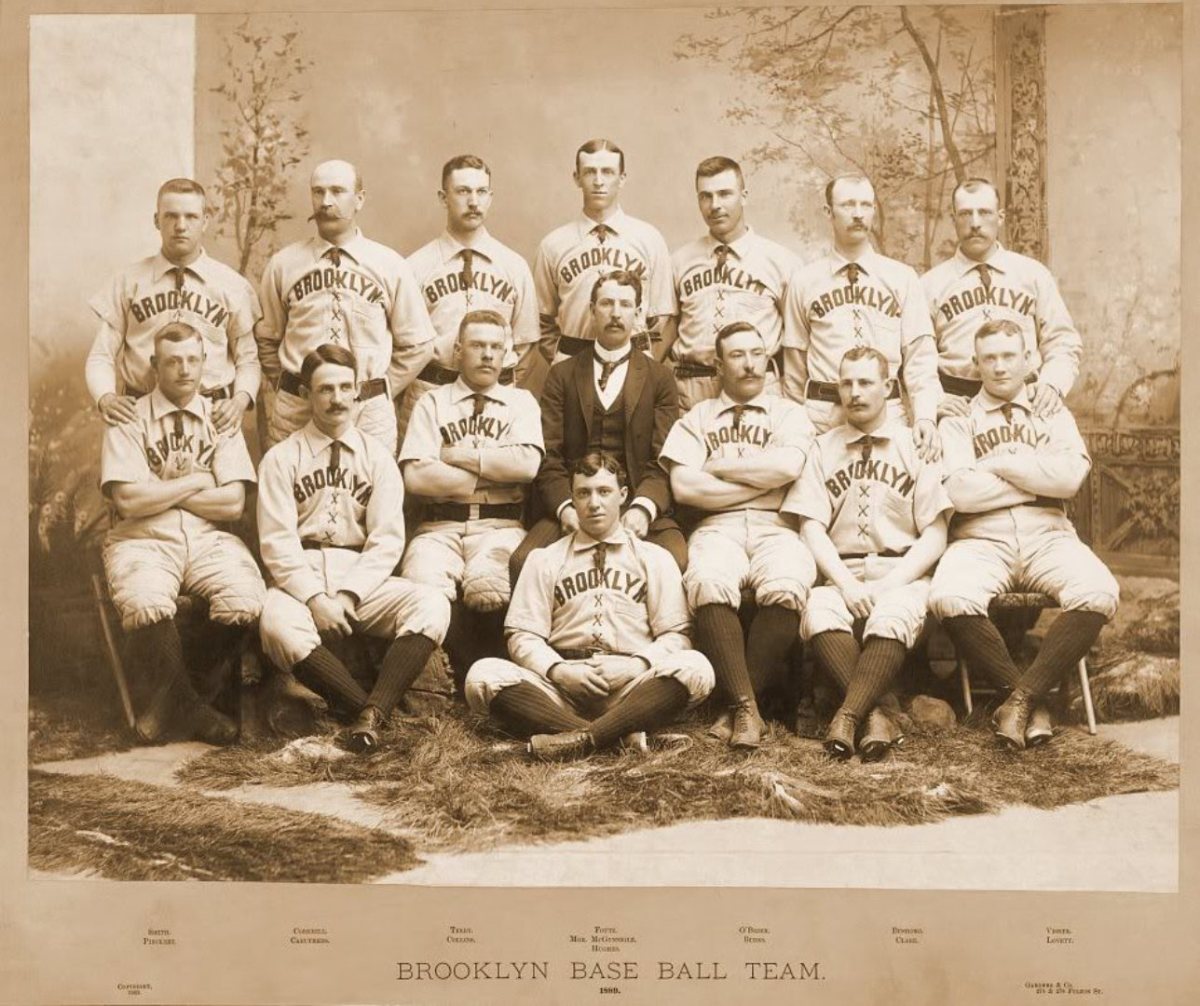
The second and third homes of the Brooklyn Dodgers were in Ridgewood in Queens between 1886 to 1889.

The second and third homes of the Brooklyn Dodgers were in Ridgewood in Queens between 1886 to 1889.

The Brooklyn Dodgers were founded in 1883 by Charles Byrne. Known simply as The Brooklyn’s, the team set up its stadium in the Park Slope neighborhood of Brooklyn and called it Washington Park. It was the local reporters that nicknamed the team The Grays, a nickname that was used through 1887 save for the year of 1884, when they were known as The Atlantics.

During the summer of 1886, in order to avoid the blue laws of the city of Brooklyn on the Sabbath, the Brooklyn Grays played 14 Sunday games at Grauer’s Ridgewood Park along with one exhibition game.

As you can see from this map, Grauer’s Ridgewood Park, which is the top arrow, was located just north of where Wallace’s Ridgewood Park was located. This was the second home of the Brooklyn Dodgers, and as I had to pass it in order to get to Wallace’s Ridgewood Park, I also filmed the location of the second home of The Brooklyn Dodgers which was located between Cypress and Seneca Avenues, and George and Weirfield streets.

The cost to play their Sunday games at Grauer’s Ridgewood Park was very high, which cut into any profits that could be made by charging for Sunday admission. The other Ridgewood Park in the area, Wallace’s, had already been playing host to amateur baseball clubs, and had even scheduled a world heavyweight boxing fight featuring John L. Sullivan. While the fight was called off as the pugilists prepared to duke it out, the attendance was still 5,000 men, certainly something to catch the attention of club owners.

Beginning in 1887, The Brooklyn Grays began to play their Sunday games at Wallace’s Ridgewood Park and it would be the site of their third home for the next three seasons. In fact the team was playing there when, in the summer of 1888, six of the Brooklyn players got married. For the remainder of their time at Ridgewood Park they were nicknamed the Brooklyn Bridegrooms, a name that stuck for the next ten years either as the Bridegrooms or simply the Brooklyn Grooms.

In the baseball history books, Wallace’s Ridgewood Park is commonly known as Ridgewood Park 2, with Grauer’s Ridgewood Park being known as Ridgewood Park 1. The area that I am walking in today is now located in Bushwick in Brooklyn, between Wyckoff and Irving Ave’s, and between Halsey and Covert Streets. At the time that the ballpark was located here though, the area was then located in Ridgewood, Queens before the boundaries changed, except for a corner of the stadium right where Halsey and Irving meet, which was located in Brooklyn.

In my John L. Sullivan story, I tell the tale of how the fighters came to box in Queens but were prevented from doing so by the police. A patron then told the fighters that a corner of the stadium was actually located in Brooklyn, and the fighters then agreed to fight in that corner of the stadium. Unfortunately a rat threatened to snitch on them and they were prevented from fighting in Brooklyn as well.